





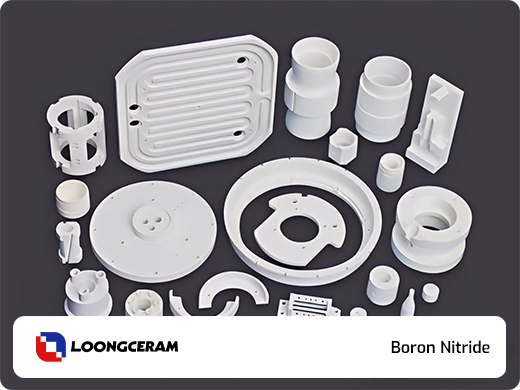
优势
为了制造固体形状,六方氮化硼(hBN)粉末和粘合剂在高达2000 psi的压力和高达2000°C的温度下热压成高达490 mm x 490 mm x 410 mm的坯料。这一过程形成了一种致密、易于加工且随时可用的材料。它几乎有任何可加工的定制形状,具有独特的特性和物理性能,这使其在解决各种工业应用中的难题方面具有价值。
- 优异的抗热震性
- 高电阻率——不包括气溶胶、油漆和 ZSBN 级
- 低密度
- 高导热性
- 各向异性(平行于和垂直于压制方向的平面之间的热导率不同)
- 耐腐蚀
- 良好的化学惰性
- 耐高温材料
- 高介电击穿强度,>40 KV/mm
- 低介电常数,k=4
- 优异的可加工性
材料等级
LCBN1000
LCBN3000
LCBN6000
LCBN11000
Grade AX05
常规特性
PCBN1000是一种热压氮化硼,专为最苛刻的应用而设计。这种高纯度材料被设计为具有低热膨胀性,同时具有优异的热冲击性能。
PCBN1000易于加工,具有优异的导热性,在使用中具有非常低的热循环行为,并且对熔融金属和玻璃具有良好的耐化学性。即使在高温下,材料的润滑性也能实现低摩擦值。它也是一种具有高介电强度和电阻率的电绝缘体。
PCBN1000非常适合需要氮化硼和最少粘合剂的高温应用。其直径可达300mm,长度可达300mm。
PCBN1000易于加工,具有优异的导热性,在使用中具有非常低的热循环行为,并且对熔融金属和玻璃具有良好的耐化学性。即使在高温下,材料的润滑性也能实现低摩擦值。它也是一种具有高介电强度和电阻率的电绝缘体。
PCBN1000非常适合需要氮化硼和最少粘合剂的高温应用。其直径可达300mm,长度可达300mm。
应用
- 霍尔效应推进器的电力推进放电通道
- 高温炉固定板
- 熔融玻璃和金属坩埚
- 高温高压用电绝缘体
- 等离子室衬里和配件
- 有色金属和合金喷嘴
- 热电偶保护管和护套
- 激光支架
常规特性
PCBN3000是一种独特的热压氮化硼,专为最苛刻的应用而设计。这种高纯度材料表现出非常低的热膨胀和出色的热冲击性能。
无粘合剂PCBN3000是硬度最低的六方氮化硼(hBN)。它很容易加工到非常严格的公差,具有优异的导热性、非常低的热循环行为,并且在非常高的温度下对熔融金属具有良好的耐化学性。材料的润滑性使摩擦值低。它在2000°C范围内与石墨和难熔金属不反应。
PCBN3000也是一种电绝缘体,在极端温度下具有高介电强度和电阻率。PCBN3000非常适合需要无粘合剂氮化硼的高温应用。它可以加工成大尺寸的坯料,尺寸可达490mm x 490mm x 400mm。
无粘合剂PCBN3000是硬度最低的六方氮化硼(hBN)。它很容易加工到非常严格的公差,具有优异的导热性、非常低的热循环行为,并且在非常高的温度下对熔融金属具有良好的耐化学性。材料的润滑性使摩擦值低。它在2000°C范围内与石墨和难熔金属不反应。
PCBN3000也是一种电绝缘体,在极端温度下具有高介电强度和电阻率。PCBN3000非常适合需要无粘合剂氮化硼的高温应用。它可以加工成大尺寸的坯料,尺寸可达490mm x 490mm x 400mm。
应用
高温炉固定板非氧化物陶瓷、荧光粉和金属坩埚用于极端高温和高压的电气绝缘暴露在熔融盐中的组件霍尔效应推进器绝缘体有色金属和合金喷嘴热电偶保护管和护套激光支架
常规特性
PCBN6000是一种各向同性多孔纯氮化硼,具有高温性能、低热膨胀、良好的润滑性和热冲击性能。它是一种在极端温度下具有高介电强度的电绝缘体。它可以加工成高达420 x 440 x 100mm的形状。
应用
高温炉固定板非氧化物陶瓷、荧光粉和金属坩埚用于极端高温和高压的电气绝缘霍尔效应推进器绝缘体热电偶保护管和护套
常规特性
PCBN11000是一种热压纯氮化硼,具有高温性能、极低的热膨胀、良好的润滑性和优异的热冲击性能。它是一种电绝缘体,在极端温度下具有高介电强度和电阻率。
应用
- 高温炉固定板
- 非氧化物陶瓷、荧光粉和金属坩埚
- 用于极端高温和高压的电气绝缘
- 霍尔效应推进器绝缘体
- 热电偶保护管和护套
常规特性
AX05级氮化硼是可用的最高纯度六方氮化硼(hBN)固体之一。对于耐腐蚀性比耐磨性更重要的应用来说,这是一个不错的选择。它是一种扩散结合陶瓷,不依赖于B2O3或其他粘合剂来实现机械完整性。因此,它几乎不会被所有熔融金属弄湿。这种超纯优势允许其他热压氮化硼固体无法提供的应用,例如用于高纯度熔融金属的坩埚。它通常用于需要非常高导热性的应用,如带有小孔的喷嘴。
关键特性
化学
AX05级具有极高的惰性,不会被许多熔融材料(如金属、玻璃、卤化物盐和其他试剂)弄湿。化学稳定性使AX05级能够为喷嘴、馈通、坩埚和支架提供稳定、无反应的材料。
热稳定性
AX05级具有最小的热膨胀、高导热性,在某些惰性气氛中的使用温度超过2000°C。热冲击稳定性在广泛的使用温度范围内表现出色。
机械
AX05级的相对强度随温度而增加。这一重要特征为以前B2O3和其他结合的氮化硼无法实现的应用提供了更高的温度性能。
电性
AX05级对微波能量透明。它还具有高电阻率和介电强度,损耗角正切和介电常数低。这些特性使AX05成为大功率低损耗绝缘体、容器和夹具的优良材料。
可加工性
AX05级可以使用标准高速“工具钢”设备加工到非常接近的公差。如果需要首选或严格的公差,可以使用研磨加工。螺纹可以用丝锥和模具加工。不得以任何理由使用切削油和冷却液。
关键特性
化学
AX05级具有极高的惰性,不会被许多熔融材料(如金属、玻璃、卤化物盐和其他试剂)弄湿。化学稳定性使AX05级能够为喷嘴、馈通、坩埚和支架提供稳定、无反应的材料。
热稳定性
AX05级具有最小的热膨胀、高导热性,在某些惰性气氛中的使用温度超过2000°C。热冲击稳定性在广泛的使用温度范围内表现出色。
机械
AX05级的相对强度随温度而增加。这一重要特征为以前B2O3和其他结合的氮化硼无法实现的应用提供了更高的温度性能。
电性
AX05级对微波能量透明。它还具有高电阻率和介电强度,损耗角正切和介电常数低。这些特性使AX05成为大功率低损耗绝缘体、容器和夹具的优良材料。
可加工性
AX05级可以使用标准高速“工具钢”设备加工到非常接近的公差。如果需要首选或严格的公差,可以使用研磨加工。螺纹可以用丝锥和模具加工。不得以任何理由使用切削油和冷却液。
应用
- Therma高温电绝缘体和真空炉支架,需要电阻率、高温强度、抗热冲击性和低化学反应性
- 高纯度熔融金属坩埚和容器
- 需要高温纯度和电绝缘的离子注入系统的绝缘体和源夹具
- 用于加工其他需要稳定、惰性表面的先进材料的沉降板
- 粉末金属喷涂喷嘴
粘合剂/复合材料等级
PCBN1000
PCBN4000
PCBN5000
PCBN9000
Grade A
Grade HP
Grade M/M26
常规特性
PCBN2000是一种热压氮化硼/二氧化硅复合材料,具有优异的介电性能和绝缘性能。这种材料具有优异的抗热冲击性,同时具有低热膨胀性。
PCBN2000易于加工,并且对氮化硼具有良好的抗弯强度。
PCBN2000易于加工,并且对氮化硼具有良好的抗弯强度。
应用
- 霍尔效应推进器的电力推进放电通道
- 等离子/电晕绝缘体
- PVD系统中的等离子体约束
- 耐磨性和耐腐蚀性
- 超高真空绝缘子
常规特性
PCBN4000是一种独特的热压氮化硼,专为最苛刻的应用而设计。这种更坚固、更硬的氮化硼等级具有低热膨胀和优异的热冲击性能。
PCBN4000是六方氮化硼的经济型主力级产品。它很容易加工到非常严格的公差,具有良好的导热性,非常低的热循环行为,对熔融金属的耐化学性超过1000°C。材料的润滑性使摩擦值低。
PCBN4000的性能非常适合需要硼酸钙玻璃粘合剂强度的地方。它可以加工成大尺寸的坯料,尺寸可达490mm x 490mm x 400mm。
PCBN4000也是一种具有出色性能的电绝缘体,保持高介电强度和高达1000°C的电阻率。
PCBN4000是六方氮化硼的经济型主力级产品。它很容易加工到非常严格的公差,具有良好的导热性,非常低的热循环行为,对熔融金属的耐化学性超过1000°C。材料的润滑性使摩擦值低。
PCBN4000的性能非常适合需要硼酸钙玻璃粘合剂强度的地方。它可以加工成大尺寸的坯料,尺寸可达490mm x 490mm x 400mm。
PCBN4000也是一种具有出色性能的电绝缘体,保持高介电强度和高达1000°C的电阻率。
Applications
- 熔炉的固定板
- 非氧化物陶瓷、荧光粉和金属坩埚
- 高温高压电气绝缘
- 暴露在熔融盐中的组件
- 有色金属和合金喷嘴
- 热电偶保护管和护套
常规特性
PCBN5000是一种热压氮化硼,专为最苛刻的应用而设计。正是这些特性的结合,以及它的可加工性,使它成为一种用途广泛且有价值的等级。
这种独特的六方氮化硼(hBN)由结合在二氧化硅基质中的高纯度BN晶体组成。这赋予了它其他氮化硼等级所不具备的防潮性。它很容易加工到非常小的公差。
PCBN5000相对较高的断裂韧性来自其偏转裂纹扩展的能力。此外,与石英玻璃类似,它可以在短时间内超过其规定的温度范围。它不会产生热冲击。如果被带回,它的形状和特性将保持不变。它可以加工成大尺寸的坯料,尺寸可达490mm x 490mm x 400mm。
PCBN5000也是一种电绝缘体,具有出色的介电和微波性能,保持高介电强度和高达1000C的电阻率。
这种独特的六方氮化硼(hBN)由结合在二氧化硅基质中的高纯度BN晶体组成。这赋予了它其他氮化硼等级所不具备的防潮性。它很容易加工到非常小的公差。
PCBN5000相对较高的断裂韧性来自其偏转裂纹扩展的能力。此外,与石英玻璃类似,它可以在短时间内超过其规定的温度范围。它不会产生热冲击。如果被带回,它的形状和特性将保持不变。它可以加工成大尺寸的坯料,尺寸可达490mm x 490mm x 400mm。
PCBN5000也是一种电绝缘体,具有出色的介电和微波性能,保持高介电强度和高达1000C的电阻率。
应用
常规特性
采用硼酸钙粘结剂的PCBN9000级具有良好的机械和热性能、低热膨胀、优异的抗热震性和强电性能。PCBN9000级是轻金属加工、铸造喷嘴、PVD涂层和焊盘等的理想选择。
应用
常规特性
氮化硼是除最严重的耐火材料应用外的所有应用的绝佳选择。它是一种高性能材料,含有玻璃态B2O3粘合剂,可产生坚硬致密但完全可加工的材料。
A级是热压氮化硼最古老的形式。50多年前,A级被指定为应用,但在传统半导体设备和国防应用中,作为相对高温的绝缘体,A级仍然有大量的替代业务。可以生产高达410mm x 495mm x 245mm的组件。然而,其B2O3粘合剂具有吸湿性,在储存和使用过程中必须注意确保组件与水分隔离。精密陶瓷采用多种包装方法来保持其加工部件的高质量。
A级是热压氮化硼最古老的形式。50多年前,A级被指定为应用,但在传统半导体设备和国防应用中,作为相对高温的绝缘体,A级仍然有大量的替代业务。可以生产高达410mm x 495mm x 245mm的组件。然而,其B2O3粘合剂具有吸湿性,在储存和使用过程中必须注意确保组件与水分隔离。精密陶瓷采用多种包装方法来保持其加工部件的高质量。
应用
General Properties
Grade HP is the workhorse grade of Boron Nitride. It is useful when low thermal expansion, high thermal shock resistance, and strong electrical properties are required. Grade HP was developed with a calcium borate glass binder in order to minimize the moisture issues of Grade A. It is available in sizes up to 410mm x 495mm x 245mm. It finds many diverse applications with its excellent machinability and maximum use temperature over 1000°C in inert or vacuum atmospheres.
Boron Nitride Grade HP is a superior solid grade for formulations of less than 1000°C. Additionally, Grade HP has ten times the moisture resistance of Grade A. It is commonly used for many light metal applications such as Al, Ti, Mg, and Zn.
Key Properties
Chemically
Grade HP has high corrosion resistance due to the addition of boron nitride. It has ten times the moisture resistance of other boron nitride solids due to the addition of calcium, which combines with boric oxide to form calcium borate.
Thermally
Excellent thermal shock resistance and conductivity – commonly used in many light metal applications such as Al, Ti, Mg, and Zn.
Electrically
Low dielectric constant material – also commonly used in many high temperature insulators.
Machinability
Like other grades of Boron Nitride, Grade HP can be machined using standard high speed ‘tool steel’ equipment. Machining by grinding may be used if preferred or stringent tolerances are required.
Boron Nitride Grade HP is a superior solid grade for formulations of less than 1000°C. Additionally, Grade HP has ten times the moisture resistance of Grade A. It is commonly used for many light metal applications such as Al, Ti, Mg, and Zn.
Key Properties
Chemically
Grade HP has high corrosion resistance due to the addition of boron nitride. It has ten times the moisture resistance of other boron nitride solids due to the addition of calcium, which combines with boric oxide to form calcium borate.
Thermally
Excellent thermal shock resistance and conductivity – commonly used in many light metal applications such as Al, Ti, Mg, and Zn.
Electrically
Low dielectric constant material – also commonly used in many high temperature insulators.
Machinability
Like other grades of Boron Nitride, Grade HP can be machined using standard high speed ‘tool steel’ equipment. Machining by grinding may be used if preferred or stringent tolerances are required.
Applications
General Properties
Solid Boron Nitride Grade M/M26 is a hydrophobic advanced ceramic. Composed of boron nitride and silica, it is completely resistant to moisture. This grade has successfully passed MIL-I-10A grade of L542 test, which is a procedure requiring immersion in water for 48 hours prior to testing at elevated frequencies. Grade M/M26 is suitable for the most severe electrical applications. It is an excellent refractory material at temperatures up to 1400°C and is unparalleled in resistance to thermal shock.
Applications
- High temperature electrical insulators and vacuum furnace supports which require electrical resistivity, high temperature strength, thermal shock resistance, and low chemical resistivity
- Crucibles and containers for high purity molten metals
- Tools and refractories for glass forming which provide non-wetting, non-B2O3 containing contacts
- Radar components and antenna windows which require exacting electrical and thermal properties
机械等级
PCBN7000
PCBN8000
Grade ZSBN
常规特性
PCBN7000级结合了热压氮化硼的热性能和可加工性以及氧化锆的强度和韧性。其特性使其成为熔融金属应用的理想选择,还具有机械耐用性和优异的电绝缘性。
应用
- 戒指断裂
- 坩埚和容器
- 夹具
- 高温轴承
- 高温阀门
- 模具
- 喷嘴
- 热处理夹具
General Properties
Grade PCBN8000 combines the thermal performance and machinability of hot-pressed boron nitride with the strength and toughness of Silicon Nitride. Its properties make it ideal for molten metal applications, also offering mechanical durability and superior electrical insulation.
Applications
- Break Rings
- Crucibles & Containers
- Jigs
- High temperature bearings
- High temperature valves
- Molds
- Nozzles
- Heat treatment fixtures
General Properties
Grade ZSBN boron nitride is a composite material combining the best thermal performance and machinability characteristics of hot-pressed boron nitride with the strength, wear-resistance, and non-reactivity of silicon carbide and zirconia. It was developed for demanding applications requiring the combination of thermal conductivity, high wear resistance, and corrosion resistance.
Originally developed for break rings for horizontal continuous casters, its unique thermal, chemical, electrical, wear, and machinability properties permit a wide variety of molten metal contact applications. Hexagonal Boron Nitride (hBN) is an inherently soft material. However, with ZSBN’s hard zirconia particles evenly dispersed with boron nitride platelets in the hard borosilicate glass matrix, it has great wear-resistant properties in addition to the inherent non-wetting aspects of the hBN.
ZSBN is a uniquely high-performing solid that is especially suited for molten metal applications such as continuous casting break rings, where wear-resistance and thermal conductivity are essential. Other applications include molten metal atomizing nozzles, glass contact wear components, and countless guides and rollers in diverse light metal baths of Zn, Mg, Al, and Li.
Key Properties
Chemically
Unparalleled resistance to molten metal wetting due to boron nitride content.
Thermally
Excellent high temperature operation and thermal shock resistance.
Mechanically
Excellent wear-resistance and increased strength from zirconia and a small amount of silicon carbide. Remarkable corrosion-resistance over a wide range of temperatures.
Machinability
Grade ZSBN is easily machined, even to complex shapes and forms, quickly and inexpensively. Machining tolerances of 0.002” or better are achievable.
Originally developed for break rings for horizontal continuous casters, its unique thermal, chemical, electrical, wear, and machinability properties permit a wide variety of molten metal contact applications. Hexagonal Boron Nitride (hBN) is an inherently soft material. However, with ZSBN’s hard zirconia particles evenly dispersed with boron nitride platelets in the hard borosilicate glass matrix, it has great wear-resistant properties in addition to the inherent non-wetting aspects of the hBN.
ZSBN is a uniquely high-performing solid that is especially suited for molten metal applications such as continuous casting break rings, where wear-resistance and thermal conductivity are essential. Other applications include molten metal atomizing nozzles, glass contact wear components, and countless guides and rollers in diverse light metal baths of Zn, Mg, Al, and Li.
Key Properties
Chemically
Unparalleled resistance to molten metal wetting due to boron nitride content.
Thermally
Excellent high temperature operation and thermal shock resistance.
Mechanically
Excellent wear-resistance and increased strength from zirconia and a small amount of silicon carbide. Remarkable corrosion-resistance over a wide range of temperatures.
Machinability
Grade ZSBN is easily machined, even to complex shapes and forms, quickly and inexpensively. Machining tolerances of 0.002” or better are achievable.
Applications
- Break rings for continuous casting of metals
- Components
- Crucibles
- Deck plates
- Heat treatment fixtures
- High temperature bearings
- High temperature mechanical components
- High temperature valves
- Jigs
- Molds
- Molten metal and glass castings
- Muffles
- Nozzles for transfer or atomization
- Side dams
- Spacers
氮化硼特性
Mechanical Properties
Thermal Properties
Electrical Properties
| Pure Grades | Binder / Composite Grades | Mechanical Grades | ||||||||||||||
|---|---|---|---|---|---|---|---|---|---|---|---|---|---|---|---|---|
| Property | Unit | PCBN1000 | PCBN3000 | PCBN6000 | PCBN11000 | Grade AX05 | PCBN2000 | PCBN4000 | PCBN5000 | PCBN9000 | Grade A | Grade HP | Grade M26 | PCBN7000 | PCBN8000 | Grade ZSBN |
| Density | g/cm3 | 1.9 | 1.9 | 1.6 | 1.9 | 1.9 | 2.1 | 1.85-2.05 | 2.0 | 1.9 | 2.0 | 2.0 | 2.1 | 2.9 | 2.3 | 2.9 |
| Compressive Strength | MPa | 40 ∥ / 40 ⊥ | 24 ∥ | – | 22 ∥ / 23 ⊥ | 25 ∥ | 312 ∥ / 312 ⊥ | 95 ∥ | – | 52 ∥ / 60 ⊥ | 143 ∥ / 186 ⊥ | 96 ∥ | – | 170 ∥ / 170 ⊥ | 270 ∥ / 315 ⊥ | 219 ∥ / 254 ⊥ |
| Flexural Strength | MPa | 13 ∥ / 29 ⊥ | 21 ∥ / 20 ⊥ | 28 | 10 ∥ / 8 ⊥ | 22 ∥ / 21 ⊥ | >49 ∥ / 49 ⊥ | 58 ∥ / 44 ⊥ | 61 ∥ / 33 ⊥ | 45 ∥ / 35 ⊥ | 94 ∥ / 65 ⊥ | 59 ∥ / 45 ⊥ | 62 ∥ / 34 ⊥ | 120 ∥ / 80 ⊥ | 120 ∥ / 95 ⊥ | 144 ∥ / 107 ⊥ |
| Young’s Modulus | GPa | – | 45 ∥ / 73 ⊥ | 12 | 23 ∥ / 20 ⊥ | 17 ∥ / 71 ⊥ | – | 39 ∥ / 58 ⊥ | – | 30 ∥ / 25 ⊥ | 47 ∥ / 74 ⊥ | 40 ∥ / 60 ⊥ | – | 45 ∥ / 30 ⊥ | 45 ∥ / 30 ⊥ | 71 ∥ / 71 ⊥ |
Note: ∥ = Parallel and ⊥ = Perpendicular
| Pure Grades | Binder / Composite Grades | Mechanical Grades | ||||||||||||||
|---|---|---|---|---|---|---|---|---|---|---|---|---|---|---|---|---|
| Property | Unit | PCBN1000 | PCBN3000 | PCBN6000 | PCBN11000 | Grade AX05 | PCBN2000 | PCBN4000 | PCBN5000 | PCBN9000 | Grade A | Grade HP | Grade M26 | PCBN7000 | PCBN8000 | Grade ZSBN |
| Thermal Conductivity | W/mK | 21 ∥ / 21 ⊥ | 73 ∥ / 128 ⊥ | 60 | 20 ∥ / 30 ⊥ | 78 ∥ / 130 ⊥ | – | 27 ∥ / 29 ⊥ | 11 ∥ / 26 ⊥ | 33 ∥ / 35 ⊥ | 30 ∥ / 34 ⊥ | 27 ∥ / 29 ⊥ | 11 ∥ / 29 ⊥ | 28 ∥ / 38 ⊥ | 27 ∥ / 45 ⊥ | 24 ∥ / 34 ⊥ |
| Max Temp (Oxidizing) 1 | °C | 850 | 850 | 850 | 900 | 850 | 850 | 850 | 1000 | 900 | 850 | 850 | 1000+ | 900 | 900 | 850 |
| Max Temp (Inert) 1 | °C | 2000 | 2000 | 2100 | 2000 | 2000 | 1000 | 1200 | 1000 | 1500 | 1200 | 1150 | 1000+ | 1800 | 1800 | 1600 |
| CTE2 25°C ➞ 400°C | 10-6/K | – | -2.3 ∥ / -0.7 ⊥ | -0.6 | 1.0 ∥ / 0.5 ⊥ | -2.3 ∥ / -0.7 ⊥ | – | 0.6 ∥ / 0.4 ⊥ | 3.0 ∥ / 0.4 ⊥ | 4.0 ∥ / 3.0 ⊥ | 3.0 ∥ / 3.0 ⊥ | 0.6 ∥ / 0.4 ⊥ | 3.0 ∥ / 0.4 ⊥ | 8.0 ∥ / 4.0 ⊥ | 4.6 ∥ / 2.5 ⊥ | 4.1 ∥ / 3.4 ⊥ |
| CTE2 400°C ➞ 800°C | 10-6/K | – | -2.5 ∥ / 1.1 ⊥ | – | – | -2.5 ∥ / 1.1 ⊥ | – | 1.1 ∥ / 0.8 ⊥ | 5.6 ∥ / 4.3 ⊥ | – | 2.0 ∥ / 1.4 ⊥ | 1.1 ∥ / 0.8 ⊥ | 2.5 ∥ / 0.1 ⊥ | – | – | 5.6 ∥ / 4.3 ⊥ |
| CTE2 800°C ➞ 1200°C | 10-6/K | – | 1.6 ∥ / 0.4 ⊥ | – | – | 1.6 ∥ / 0.4 ⊥ | – | 1.5 ∥ / 0.9 ⊥ | 7.2 ∥ / 5.2 ⊥ | – | 1.9 ∥ / 1.8 ⊥ | 1.5 ∥ / 0.9 ⊥ | 3.0 ∥ / 0.1 ⊥ | – | – | 7.2 ∥ / 5.2 ⊥ |
| CTE2 1200°C ➞ 1600°C | 10-6/K | – | 0.9 ∥ / 0.3 ⊥ | – | – | 0.9 ∥ / 0.3 ⊥ | – | 2.8 ∥ / 2.7 ⊥ | 4.6 ∥ / 3.4 ⊥ | – | 5.0 ∥ / 4.8 ⊥ | 2.8 ∥ / 2.7 ⊥ | – | – | – | 4.6 ∥ / 3.4 ⊥ |
| CTE2 1600°C ➞ 1900°C | 10-6/K | – | 0.5 ∥ / 0.9 ⊥ | – | – | 0.5 ∥ / 0.9 ⊥ | – | – | – | – | 7.2 ∥ / 6.1 ⊥ | – | – | – | – | – |
| CTE2 25°C ➞ 1000°C | 10-6/K | 5.5 ∥ / 1 ⊥ | – | – | – | – | 2.5 ∥ / 2.0 ⊥ | – | – | – | – | – | – | – | – | – |
| Pure Grades | Binder / Composite Grades | Mechanical Grades | ||||||||||||||
|---|---|---|---|---|---|---|---|---|---|---|---|---|---|---|---|---|
| Property | Unit | PCBN1000 | PCBN3000 | PCBN6000 | PCBN11000 | Grade AX05 | PCBN2000 | PCBN4000 | PCBN5000 | PCBN9000 | Grade A | Grade HP | Grade M26 | PCBN7000 | PCBN8000 | Grade ZSBN |
| Dielectric Strength | kV/mm | >40 | >40 | >40 | 63 | 79 | – | >40 | >40 | 100 | 88 | >10 | 66 | – | 100 | 3.5 |
| Dielectric Constant | 1 MHz | – | 4.0 ∥ / 4.0 ⊥ | 4.9 | – | 4.0 ∥ / 4.0 ⊥ | – | 4.3 ∥ / 4.0 ⊥ | 4.5 ∥ / 3.8 ⊥ | – | 4.6 ∥ / 4.2 ⊥ | 4.3 ∥ / 4.0 ⊥ | 4.5 ∥ / 3.8 ⊥ | – | – | 18 ∥ / 19 ⊥ |
| Dissipation Factor | 1 MHz | – | 1.2E-3 ∥ / 3.0E -4 ⊥ | 1.0E -3 | – | 1.2E-3 ∥ / 3.0E-3 ⊥ | – | 1.5E -3 ∥ / 2.1E -3 ⊥ | 1.7E -3 ∥ / 6.7E -3 ⊥ | – | 1.2E-3 ∥ / 3.4E-3 ⊥ | 1.5E-3 ∥ / 2.1E-3 ⊥ | 1.7E-3 ∥ / 6.7E-3 ⊥ | – | – | 4.5E-2 ∥ / 6.7E-2 ⊥ |
| Volume Resistivity @25°C | ohm-cm | >1014 / 1014 ⊥ | >1013 ∥ / 1014 ⊥ | 1015 | >1015 | >1013 ∥ / 1014 ⊥ | – | >1013 ∥ / 1013 ⊥ | >1013 ∥ / 1014 ⊥ | >1015 ∥ / 1015 ⊥ | >1013 ∥ / 1014 ⊥ | >1013 ∥ / 1013 ⊥ | >1013 ∥ / 1014 ⊥ | >1012 ∥ / 1012 ⊥ | >1015 ∥ / 1015 ⊥ | >1013 ∥ / 1012 ⊥ |
产品应用
氮化硼(BN)是为数不多的提供电绝缘和高导热性的材料之一。这使得BN在散热器和散热器应用中的大功率电子应用中非常有用。其他常用的材料是氮化铝、氧化铍,有时还有氧化铝——然而,所有这些材料都很难加工成复杂的形状。
Classified by purity